StockSense — Inventory Reorder Agent for E-Commerce
61%
Stockout Reduction
Vs. previous fixed-threshold system
27%
Excess Inventory Reduced
Reduced overordering on slow-moving SKUs
850+
SKUs Monitored
Across multiple warehouses
89%
Reorder Draft Accuracy
Approved without modification by ops team
Illustrative Project
StockSense is an illustrative example demonstrating an AI-powered inventory automation pattern, not a completed client engagement.
Overview
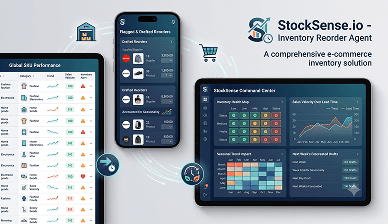
StockSense monitors inventory levels, recent sales velocity, and supplier lead times across hundreds of SKUs, and proactively drafts reorder recommendations before a stockout occurs — factoring in seasonal patterns and demand trends that a simple fixed-threshold reorder point misses entirely.
The Challenge
The previous system used static reorder thresholds per SKU, set once and rarely updated. This worked acceptably for steady-demand products but consistently failed for seasonal items — triggering stockouts during demand spikes and excess inventory during slow periods, because a static threshold has no concept of trend or seasonality.
Architecture & Technical Decisions
Demand Forecasting as Input, Not the Whole System
Rather than building the agent around a complex standalone forecasting model, I used a lighter statistical trend analysis (moving averages with seasonal adjustment) as a structured input that the agent reasons over, combined with supplier lead time and current stock level, to produce a recommended reorder point and quantity with explicit reasoning.
Reasoning-Visible Recommendations
Every reorder recommendation includes the agent's stated reasoning — current stock, recent velocity, lead time, and seasonal context — so the operations team can quickly sanity-check a recommendation rather than trusting a black-box number. This visibility was critical to getting the team comfortable relying on the system.
Tiered Autonomy by SKU Risk Profile
Low-cost, high-velocity SKUs with stable demand patterns were configured for automatic reorder submission once the system proved reliable on them. Higher-cost or highly seasonal SKUs remained in human-approval mode, where the agent drafts the recommendation but a person confirms before the order is placed.
- Trend and seasonal adjustment as structured input to the agent's reasoning, not a separate opaque model
- Explicit reasoning attached to every recommendation for ops team review
- Tiered autonomy — auto-submit for stable, low-risk SKUs; human approval for higher-stakes ones
- Continuous tracking of recommendation accuracy to inform which SKUs graduate to auto-submit
Results
- 61% reduction in stockout incidents compared to the previous fixed-threshold system
- 27% reduction in excess inventory on slow-moving and seasonal SKUs
- 850+ SKUs actively monitored across multiple warehouse locations
- 89% of draft reorder recommendations approved without modification by the operations team
What I Learned
Tiered autonomy based on SKU risk profile, rather than an all-or-nothing automation decision, was what made this system adoptable. The operations team trusted automatic reordering on stable products almost immediately, and that trust extended gradually to higher-stakes SKUs only as the system's track record on the easier cases built confidence — exactly the gradual-trust pattern that works well across most agent deployments.