OnboardAI — Automated Employee Onboarding Workflow Agent
12hrs
Coordinator Hours Saved
Per new hire, on average
99%
Onboarding Task Completion
Completed on schedule
81%
New-Hire Question Resolution
Answered by the agent directly
-3 days
Time-to-Productive
Faster than the prior manual process
Illustrative Project
OnboardAI is an illustrative example demonstrating a multi-step workflow orchestration pattern, not a completed client engagement.
Overview
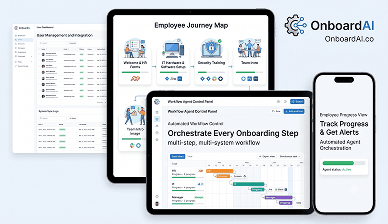
OnboardAI orchestrates the full employee onboarding sequence — account provisioning across multiple internal systems, scheduling required training sessions, sending the right documents at the right time, and answering common new-hire questions — replacing a process that previously required an HR coordinator manually tracking a checklist across five separate tools for every new hire.
The Challenge
Onboarding isn't a single task — it's a sequence of dependent steps across different systems, each with different timing requirements (some things need to happen before day one, others in the first week), and new hires inevitably have questions that don't fit a rigid FAQ. The system needed to reliably execute the structured workflow while also handling the conversational, unpredictable parts.
Architecture & Technical Decisions
Workflow Orchestration as Explicit State Machine
The structured onboarding sequence — account provisioning, equipment requests, training scheduling, document delivery — is modeled as an explicit state machine with defined steps, dependencies, and timing, executed reliably through code rather than left to an LLM to improvise the sequence. This is deliberately the less 'AI' part of the system, and that's the point: a checklist with firm dependencies doesn't need an LLM deciding what happens next, it needs to happen correctly every time.
LLM Layer for the Conversational Surface
Sitting on top of the deterministic workflow, an LLM-powered assistant handles new-hire questions — using RAG against company policy documents and the employee's specific onboarding status to answer accurately — and can trigger specific workflow actions (like rescheduling a training session) through defined tools when asked.
Escalation for Anything Outside Scope
Questions or requests outside the agent's defined scope — anything involving compensation, performance, or sensitive personal matters — are explicitly routed to a human HR contact rather than the agent attempting to handle them, with this boundary enforced as a hard rule, not a judgment call left to the model.
- Deterministic state machine for the structured, dependency-driven onboarding sequence
- RAG-powered conversational layer for new-hire questions, grounded in actual company policy
- Hard-coded escalation boundaries for sensitive topics, not left to model discretion
- Status dashboard giving HR visibility into every onboarding's current state without manual tracking
Results
- Approximately 12 hours of HR coordinator time saved per new hire onboarded
- 99% of onboarding tasks completed on schedule, up from a previously inconsistent manual process
- 81% of new-hire questions answered directly by the agent without HR involvement
- New hires reached full productivity roughly 3 days faster on average, attributed to faster access to accounts, training, and answers
What I Learned
The split between a deterministic state machine for the structured workflow and an LLM-powered layer for the conversational surface was the right architectural call from the start, but it was tempting early on to let the LLM handle more of the sequencing logic 'since it could.' Resisting that temptation and keeping the dependency-driven checklist deterministic, while reserving the LLM for genuinely conversational and judgment-light tasks, is what made the system reliable enough that HR stopped manually double-checking its work within the first month.