ComplianceWatch — Regulatory Filing Monitoring Agent
-100%
Missed Deadline Risk
Zero missed filings since rollout
65%
Checklist Prep Time Saved
Per filing, vs. manual research
14
Jurisdictions Monitored
Across multiple regulatory bodies
<24hrs
Requirement Change Detection
Time to flag a relevant regulation update
Illustrative Project
ComplianceWatch is an illustrative example demonstrating an AI-assisted regulatory monitoring pattern, not a completed client engagement.
Overview
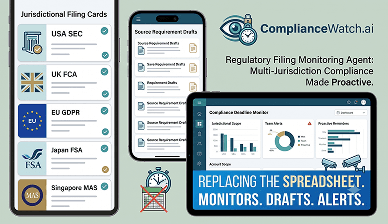
ComplianceWatch tracks regulatory filing deadlines across multiple jurisdictions, monitors for changes to filing requirements, and generates draft preparation checklists from current source requirements — replacing a manually maintained spreadsheet that depended entirely on someone remembering to check for regulatory updates.
The Challenge
Regulatory requirements change, sometimes with limited public notice, and missing a filing deadline carries real financial and legal consequences. The previous process relied on a compliance team member periodically checking regulator websites manually — reliable when remembered, but with no systematic safety net if it was missed.
Architecture & Technical Decisions
Scheduled Monitoring of Regulatory Sources
A scheduled job periodically checks each tracked regulator's public filing requirement pages and recent announcements. Changes are detected via content diffing, and an LLM call assesses whether a detected change is substantively relevant to the company's filing obligations or just a cosmetic page update — filtering out noise before anything reaches a human.
Deadline Calculation From Source Requirements
Rather than hardcoding deadline rules that go stale, the agent reads the actual current regulatory text to determine filing deadlines and required documentation, flagging discrepancies if a previously known deadline rule no longer matches what the source material currently states.
Draft Checklist Generation
For each upcoming filing, the agent generates a draft preparation checklist based on the current requirements, which the compliance team reviews and confirms — providing a documented starting point rather than requiring someone to research requirements from scratch for every filing cycle.
- Scheduled content monitoring with LLM-based relevance filtering to reduce noise
- Deadline and requirement extraction from current source text, not hardcoded static rules
- Draft checklist generation reviewed and confirmed by the compliance team, not auto-submitted
- Escalating alert cadence as a deadline approaches, with no possibility of a silent miss
Results
- Zero missed filing deadlines since the system went live, eliminating a previously real risk
- 65% reduction in time spent preparing filing checklists, since the team starts from a researched draft rather than from scratch
- 14 jurisdictions actively monitored across multiple regulatory bodies simultaneously
- Relevant regulatory changes flagged to the compliance team within 24 hours of being published
What I Learned
For compliance-adjacent systems, the agent's job isn't to make the final call — it's to make sure nothing falls through the cracks and to do the research legwork, while a human always confirms before anything is submitted. Designing the system explicitly around 'never let this be silent' rather than 'always be right' was the correct framing for a domain where a missed signal is far more costly than an occasional unnecessary alert.