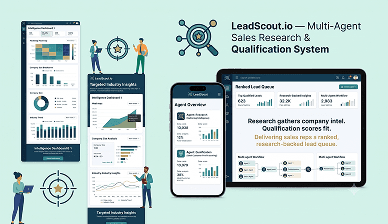
LeadScout — Multi-Agent Sales Research & Qualification System
85%
Rep Research Time Saved
Per qualified lead
91%
Qualification Accuracy
Vs. rep-validated ground truth
+34%
Lead-to-Meeting Rate
After rollout
400+
Leads Processed Daily
At steady-state volume
Illustrative Project
LeadScout is an illustrative example demonstrating a multi-agent system architecture, not a completed client engagement.
Overview
LeadScout automates the research and qualification step that happens before a sales rep ever talks to a lead — gathering company context, scoring fit against an ideal customer profile, and surfacing a ranked queue with reasoning attached, instead of reps spending the first 10-15 minutes of every lead manually researching the company.
The Challenge
Lead qualification requires two genuinely different skills: gathering relevant, current information about a company (research) and judging whether that company matches what's historically converted well (qualification). Cramming both into a single agent made the prompts unwieldy and the reasoning hard to debug when qualification scores seemed off.
Architecture & Technical Decisions
Splitting Research and Qualification Into Separate Agents
The research agent's only job is gathering and summarizing relevant company information — size, industry, recent news, technology signals — using web search and a few data provider APIs. The qualification agent receives that research summary and scores it against the ideal customer profile, with its reasoning logged separately. Splitting these let each agent's prompt stay focused and let me debug qualification accuracy issues without wondering whether the research was incomplete.
Structured Handoff Between Agents
Rather than passing free-text between agents, the research agent outputs a structured summary with explicit fields (company size, industry, technology signals, recent funding/news, confidence per field). This structured handoff made the qualification agent's job more reliable, since it wasn't trying to parse unstructured research notes.
Historical Calibration
The qualification agent's scoring prompt was calibrated against a set of historically labeled leads — known good conversions and known poor fits — and iterated until its scores correlated well with actual sales outcomes, not just intuitive plausibility.
- Research agent: web search + data provider APIs, outputs structured company profile
- Qualification agent: scores structured profile against ICP, outputs ranked score + reasoning
- pgvector-backed similarity search against historically converted accounts as an additional qualification signal
- Full reasoning trail attached to every scored lead for sales rep transparency
Results
- 85% reduction in time reps spent on manual pre-call research per lead
- 91% qualification accuracy when validated against rep-reviewed ground truth on a sample set
- 34% increase in lead-to-meeting conversion rate, attributed largely to reps prioritizing well-qualified leads first
- Sustained processing of 400+ leads per day without additional headcount
What I Learned
Splitting a complex task into specialized agents with a structured handoff made debugging dramatically easier than a single do-everything agent would have. When qualification scores looked wrong, I could isolate immediately whether the research was incomplete or the qualification reasoning was flawed — a diagnosis that's nearly impossible when both jobs are tangled into one prompt.